Pages

Showing posts with label cosmos creation. Show all posts

Saturday, November 21, 2015

Theogony - Part 4: The third generation


Greek Goddess Athena.
According to Greek Mythology, god Zeus married seven mortal and divine women. The first one was the sea nymph Oceanid Metis ("wisdom"). Metis was a sea nymph and was born of Oceanus and Tethys another sea nymph, making her much older than Zeus and later Greek gods. There was a prophesy that Metis will offspring powerful children,  one girl (later Greek goddess of wisdom Athena) and one boy that eventually will overthrown his father. As his father, he consumed her, by turning herself into a fly, to avoid giving birth the son who would overthrow him, like he did to his father god Cronus. By swallowing her, he also acquired the wisdom that the Oceanid had to make him better decisions and provide better judgment to the challenges yet to come in the future.

Unfortunately for Zeus, the Oceanid had already conceived a girl and she started preparing the armor for her. The creation of the helmet caused Zeus strong headaches, and the Greek god of blacksmiths Hephaestus hit Zeus' head with an axe (or according to another variation with a hammer), giving birth to Greek goddess of wisdom Athena. Athena spawned from Zeus's head, fully grown and armed. The birth anger the Greek goddess Hera,Queen of the Gods, and she reproduced by herself, giving birth to the monster Typhon. Note that in other variations of the Theogony myth, Hera gave birth to Greek god of blacksmiths Hephaestus.
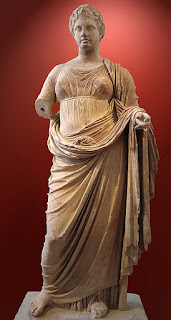
Second wife of Zeus,  Titaness Themis.
Second wife of Zeus,
Titaness Themis.
The second wife of Greek god Zeus was the Titaness Themis. Themis is the the personification of divine order, divine and natural laws. Titaness Themis born the divine hours, the goddesses of the seasons. The three divine Hours are Diki (Justice), Eirene (Peace), and Eunomia (Order).
The goddesses Hours ("seasons") reflect the seasonal changes in the nature and represents the natural justice.  She also born the three Fates (Moirai). The three Fates are Clotho (Spinner), Lachesis (Alotter), Atropos (Unturned). The Moirai or Moerae ("apportioners"-Fates) are the the deities responsible for the destiny. They have the power to control the thread of lifestyle of every mortal from birth to death. They are independent, although sometimes they directed fate, and they make sure that the proper fate assigned to every being in earth.

The third wife of Greek god Zeus was the Eurynome, another sea nymph (Oceanid). She born the three Charites (Graces): Aglaia, Euphrosyne, and Thalia. According to many statues found, she was represented as a mermaid.

The queen of the underworld, Persephone.
The fourth wife was his sister, the Greek goddess of harvest Demeter, who born the Greek goddess Persephone, that later will become the queen of the underworld. Goddess Demeter (Δημήτηρ) was responsible for the grains and the fertility of the earth. She and her daughter Persephone were worshiped before the final form of the Olympian pantheon. The Greek god of the underworld Hades will later abduct Goddess Persephone making her queen of the underworld. She is responsible for caring into effect the curses of men upon the souls of the dead.


A Muse reading scroll.
In Louvre museum.
The fifth wife of god Zeus was another Titaness, Mnemosyne. Mnemosyne (Μνημοσύνη), is the daughter of Greek God Uranus and Gaia, the great mother of everything. Mnemosyne is a divine figure that represents the ability of memory. Mortals were wanted her power of authoritative speech to achieve their goals. Mnemosyne had nine children, the Muses.The Muses are the goddesses of the inspiration of literature, science, and the arts. The considered as the source of poetry, song lyrics, and myths that humans were spreading. There are nine Muses: Melpomene, Clio, Euterpe,  Terpsikhore, Erato, Polymnia,Thalia, Urania, and Calliope.

The sixth wife of Greek god Zeus the daughter of the Titans Coeus and Phoebe, Leto. She and Zeus have two children (Letoides), the Greek god of light and prophecy Apollo and the Greek goddess of hunt Artemis. Leto born at the island of Kos, in Aegean sea. According to the Greek myth, Greek god Zeus noticed the hidden beauty of Leto and decided to mate with her. Unfortunately, the Greek goddess Heraqueen of the Gods was jealous and every place in earth was avoiding her. She finally, find an island that it is not land neither island, where she gives birth to god Apollo and the goddess Artemis. Later Leto does not play any other role later after her children grow up.

Greek goddess Hera, Queen of the Gods
Greek goddess Hera, Queen of the Gods.
The seventh and final wife is the Greek goddess HeraGoddess Hera is the wife and queen of the gods and one of three sisters of Greek god Zeus. She is the goddess of women and marriage. Hera is well known for her jealous nature against Zeus's lovers and children, and she tries every time to destroy them. Goddess Hera also hates Paris because he choose Aphrodite as the most beautiful Greek goddess. With Greek god Zeus have five children the goddesses of youth Hebe, the god of war Ares, god of war and destruction Enyo, the god of blacksmiths Hephaistos, and the goddess of childbirth Eileithyia. Greek god Zeus still had affairs with many other women, such as Semele, the mother of Greek god of wine and celebrations Dionysus, Danae (mother of Perseus), Leda, and Alkmene (the mother of the Greek hero Hercules).

The Greek god of the sea, Poseidon, married the sea-goddess Amphitrite. Under the influence of the Olympian pantheon, she became merely the consort of Poseidon, and was further diminished by poets to a symbolic representation of the sea. Here we have a contradiction: according to Theogony, Amphitrite is a daughter of Nereus and Doris (and thus a Nereid). In contrast in the Bibliotheca, she is the daughter of Oceanus and Tethys. Amphitrite god Poseidon born a merman, Triton. Note that in other sources there is a second child, a daughter, Rhode.

The Greek goddess of beauty Aphrodite, married the Greek god of blacksmiths Hephaistos, although she has an affair with the god of war Ares. She has the following children:  Eros (Love), Phobos (Fear), Deimos (Terror), and Harmonia (Harmony), Ino, Semele (mother of Dionysos), Autonoë (mother of Actaeon), Polydorus, and Agave (mother of Pentheus).

Finally, Helios and Perseis have Circe, the goddess of magic. She and Poseidon, have the god of the forestt Phaunos, and with Dionysos, she borne Comos, god of revelry and festivity. Later, Circe would later give birth to Agrius, Latinus, and Telegonos after coupling with another Greek Hero Odysseus.

Friday, November 20, 2015

Theogony - Part 3: Overthrow of Cronus

After Cronus had castrated his father Uranus, he took control of the Cosmos, wanted to ensure that he maintained power. Uranus and Gaia gave the prophecy to him that one of his children would overthrow him. Thus, when he married Rhea, he swallowing each of the children she birthed: Hestia, Demeter, Hera, Hades, Poseidon, and Zeus. Rhea (Ῥέα) is the Titaness daughter of Gaia and Uranus, and she would be the mother of the Olympian goddesses and gods as we are going to show later.

When Rhea gave birth to Zeus, asked Gaia and Uranus for help in saving him by sending her to Crete to bear Zeus. She deceived Cronus and gave him a huge stone to swallow thinking that it was another of Rhea's children. Gaia then took Zeus and hid him deep in a cave beneath the Aegean Mountains. Tricked by Gaia, Cronus ate the stone instead of the other Zeus. As the years rolled on, Zeus was growing up, and he was planning how to fight his father. Although not fully explained in "Theogony", Cronus was tricked from Rhea and Zeus and vomited up his five children and the stone which he had swallowed last. The five children joined Zeus and they waged a great war on the Titans for control of the Cosmos.


The war lasted ten years, with the Olympian gods, Cyclopes, Prometheus and Epimetheus, the children of Klymene, on one side, and the Titans and the Giants on the other.Epimetheus and Prometheus are a pair of Titans, sons of Iapetus and Clymene (daughter of Ocean), who in other contexts was the father of Atlas. While Prometheus is characterized as ingenious and clever, Epimetheus is depicted as foolish. Eventually, Zeus released the Hundred-Handed ones to shake the earth, allowing him to gain the upper hand. They remembered to be grateful to him for his kindness, and gave him thunder and the glowing thunderbolt and lightning. Zeus used his thunderbolts at the Titans, throwing them into Tartarus. Zeus later battled Typhon, a son of Gaia and Tartarus, created because Gaia was angry that the Titans were defeated, and was victorious again.

Because Prometheus helped Zeus, he was not sent to Tartarus like the other Titans. However, Prometheus sought to trick Zeus. Slaughtering a cow, he took the valuable fat and meat and sewed it inside the cow's stomach. Prometheus then took the bones and hide them with a thin layer of fat. Prometheus asked Zeus' opinion on which offering pile he found more desirable, hoping to trick the god into selecting the less desirable portion. However, Zeus saw through the trick and denied the benefit of fire to man. In response, Prometheus sneaked into the gods' chambers and stole a glowing ember with a piece of reed and gave fire to humanity. For this theft, Zeus punished Prometheus by chaining him to a cliff, where an eagle fed on his ever-regenerating liver every day. Prometheus would not be freed until Heracles, a son of Zeus, came to free him. Since man had access to fire, Zeus devised woman as a general punishment, in trade. Hephaistos and Athena built woman with exquisite detail, and she was considered beautiful by all men and gods. Despite her beauty, the woman is a bane for mankind, attributing women with laziness and a waste of resources.

In the next post, we are going to discuss the third generation of Greek Gods, children of Zeus and Poseidon. Zeus married seven wives and had numerous children.


Thursday, November 19, 2015

Theogony - Part 2: The second generation - Cronus castrating his father Uranus

As we discussed in our previous post, Uranus didn't like his children, the  Cyclopes, and the three Hecatonchires, and decided to hide them from Gaia. He threw them all into Tartarus. Gaia got angry for this and convinced her Titan children to overthrow their father god Uranus. From all the titans, only Cronus (or Cronos), the youngest and most terrible of her children, was ready to kill his father.

Painting of ancient Greek God Cronus castrating his father Uranus.
Cronus is castrating his father, Uranus.
Cronus castrated his father with a long sickle with jagged teeth, from Gaia. Uranus was losing blood, and from his scattered blood d to earth various creatures created. The blood produced Giants (Γίγαντες), Erinyes (Ερινύες-Furies), and  Meliai (Μελιάδες). Here we have a variation of the myth. According to Theogony, Cronus threw his father testicles into the Sea, creating foam. The foam transformed into the goddess of Love and desire, Aphrodite. In contrast with other texts and Greek myths, Aphrodite was the daughter of Uranus and the goddess Thalassa (Sea). Gaia married the God Pontus after Uranus's castration. They have many children, including sea deities, sea nymphs, and hybrid monsters.


Nereus (Old Man of the Sea) is child of Gaia and Pontus. According to Hesiod, "men call him the Old Man because he is trusty and gentle and does not forget the laws of righteousness". He marries Doris, a daughter of Oceanus and Tethys, and has Nereids, the fifty nymphs of the sea, one of whom is Thetis (Θέτις).  Another child of Gaia and Pontus is Thaumas (Θαύμας - "wonder"), who was a sea god. Later, Poseidon overthrew him and became the new sea god. Thaumas married Electra (Ηλέκτρα), an Oceanid, a sea nymph. The children of Thaumas and Electra were the Harpies and Iris, the goddess of rainbows and a messenger of the gods; according to some, also Arke.

Gorgons. Three sisters who had hair made  of living snakes that turned those who beheld  her to stone. Medusa is one of the most famous.
Gorgons. Three sisters who had hair made
of living snakes that turned those who beheld
her to stone. Medusa is one of the most famous.
Phorcys (Φόρκυς) is a god of the hidden dangers of the deep, as a primordial sea god. Phorcys and Ceto, two siblings, marry each other and have the Graiae, the Gorgons, Echidna, and Ophion. A Gorgon (Γοργών/Γοργώ Gorgon/Gorgo) is a female creature, and the term commonly refers to any of three sisters who had hair made of living, venomous snakes, as well as a horrifying visage that turned those who beheld her to stone. Medusa, one of the Gorgons, has two children with Poseidon: the winged horse Pegasus and giant Chrysaor, at the instant of her decapitation by Perseus. Chrysaor marries Callirhoe, another daughter of Oceanus, and has the three-headed Geryon.

Gaia also marries Tartarus and has a son Typhon. Typhon (Τυφῶν- Typhoeus - Tuphōs) was the most fearsome monster of Greek mythology. According to Hesiod, Typhon was "terrible, outrageous and lawless", and on his shoulders were one hundred snake heads, that emitted fire and every kind of noise. Typhon married Echidna, and they have Orthos, Kerberos, Hydra, and Chimera.


Lernea Hydra and Hercules.
Lernean Hydra and Hercules.
Orthrus (Ὄρθρος-Orthros) was a two-headed dog who guarded Geryon's cattle and was killed by Heracles. Cerberus (Κέρβερος-Kerberos), often called the "hound of Hades", is a monstrous multi-headed dog, who guards the gates of the underworld, preventing the dead from leaving. Hydra served as a guard at the lake of Lerna in the Argolid, that reputed to be an entrance to the Underworld. It possessed many heads and, each time one was lost, it was replaced by two more. It had poisonous breath and blood so virulent that even its scent was deadly. The Hydra was killed by Heracles as the second of his Twelve Labors. The Chimera (Chimaera-Χίμαιρα) was a monstrous fire-breathing hybrid creature, composed of the parts of more than one animal. Usually depicted as a lion, with the head of a goat arising from its back, and a tail that might end with a snake's head.

From Orthos and either Chimera or Echidna two monsters born, the Sphinx and the Nemean Lion. A sphinx (Σφίγξ) is a mythical creature with the head of a human, the haunches of a lion, and sometimes the wings of a bird. The Nemean lion (Νεμέος λέων) was a vicious monster lived at Nemea. It was eventually killed by Hercules. It could not be killed with mortals' weapons because its golden fur was impervious to attack. Its claws were sharper than mortals' swords and could cut through any armor.

According to Theogony, the Titans Oceanus and Tethys marry and have three thousand rivers
 (most notably the river Nile and Skamandar) and three thousand Oceanid Nymphs (including Electra, Calypso, and Styx). The Titans Theia and Hyperion marry and have Helios (Sun), Selene (Moon), and Eos (Dawn). Kreios and Eurybia marry to bear Astraios, Pallas, and Perses. Eos and Astraios have seven children Zephyrus, Boreas, Notos, Eosphoros, Hesperos, Phosphoros and the Stars. The Titan Pallas and Oceanid Styx have four children: Nike (Victory), Zelus (Zeal), Cratos (Strength), and Bia (Violence Force). Koios and Phoibe marry and have Leto, Asteria. Iapetos marries Klymene (another Oceanid Nymph) and they four children: Atlas, Menoetius, Prometheus, and Epimetheus.

Meanwhile, Nyx parthenogenetically produced children: Moros (Μόρος-Doom), Oneiroi (Όνειρα-Dreams), Ker and the Keres (Πεπρωμένο-Destinies), Eris (Discord), Momos (Blame), Nemesis (Retribution), Hesperides (Daughters of Night), Hypnos (Sleep), Philotes (Love), Geras (Old Age), Thanatos (Death), Moirai (Μοίρα-Fates),  Oizys (Hardship), and Apate (Deceit). Eris, following in her mother's footsteps, she parthenogenetically born Ponos (Pain), Hysmine (Battles), the Neikea (Quarrels), the Phonoi (Murders), Lethe (Oblivion), Makhai (Fight), Pseudologos (Lies), Amphilogia (Disputes), Limos (Famine), Androktasia (Manslaughters), Ate (Ruin), Dysnomia (Anarchy and Disobedient Lawlessness), the Algea (Illness), Horkos (Oaths), and Logoi (Stories). We are going to discuss Nyx and his children/grandchildren in a later blog spot more thoroughly.

In the next post, we are going to explain the overthrown of Cronus from his son Zeus that later will become with the ruler of gods.

Wednesday, November 18, 2015

Theogony - Part 1: The first generation

The Greatest source of information about the creation of the world comes from the Greek poet Hesiod. He lived between 750 and 650 BC, around the same time as Homer. In addition with the information about Greek religious customs, modern scholars refer to him as a major source on farming techniques, economic thought, archaic Greek astronomy, and ancient time-keeping. In this blog we are using his work "Theogony" that describes with many details the creation of the cosmos.


1st Generation


At the beginning there was only Chaos, a dark indefinite void that arose spontaneously. Out of the Chaos emerged Gaia (the Earth), Eros (Love), the Abyss (Tartarus), and the Erebus. Gaia was the great mother of all: creator and giver of birth to the Earth and all the Universe. Eros was representing sexual desire and serves an important role in reproduction Tartarus is the abyss that is used as a dungeon that souls were judged after death and where the wicked received divine punishment and as the prison for the Titans laterIn addition, from Chaos came Erebus, the place of darkness between the earth and the underworld, and Nyx (Night). Erebus and Nyx coupled to make Aether (Light) and Hemera (Day). 


From Gaia came Uranus (Sky), the Ourea (Mountains), and Pontus (Sea). Uranus mated with Gaia and they created twelve female and male Titans. The male titans were Cronus, Iapetus,
Coeus,  Hyperion,  Oceanus, and Crius. In addition, the six females were Themis, Phoebe, Tethys, Mnemosyne,  Rhea, and Theia. Titans were giant deities of incredible strength, who ruled during the legendary Golden Age, and also composed the first pantheon of Greek gods.
Family tree of the 1st generation of ancient Greek Gods according to Theogony/
After Cronus was born, Gaia and Uranus decided that no more Titans were to be born. They were followed by the one-eyed Cyclopes (Brontes, Steropes and Arges) and the Hecatonchires "Hundred-Handed" Ones (Kottos, Briareos, and Gyges). Hesiod described Cyclopes as one-eyed primordial giants. The Hekatonkheires or Hecatonchires (Ἑκατόγχειρες - "hundred-handed ones" - Centimanes), were figures in during the first generation of Gods of Greek mythology, three giants of incredible strength and ferocity that surpassed all of the Titans, whom they helped overthrow.

Uranus throw all of them into Tartarus. This made Gaia furious and it was the begining of a set of events that overthrown Cronus and started the 2nd generation of Greek Gods as we explain in our next post.


Ὅσσοι γὰρ Γαίης τε καὶ Οὐρανοῦ ἐξεγένοντο,
δεινότατοι παίδων, σφετέρῳ δ᾽ ἤχθοντο τοκῆι        
ἐξ ἀρχῆς· καὶ τῶν μὲν ὅπως τις πρῶτα γένοιτο,
πάντας ἀποκρύπτασκε, καὶ ἐς φάος οὐκ ἀνίεσκε,
Γαίης ἐν κευθμῶνι, κακῷ δ᾽ ἐπετέρπετο ἔργῳ
Οὐρανός. ἣ δ᾽ ἐντὸς στοναχίζετο Γαῖα πελώρη
στεινομένη· δολίην δὲ κακήν τ᾽ ἐφράσσατο τέχνην. 


For of all the children that were born of Earth and Heaven, 

these were the most terrible, and they were hated 
by their own father from the first. 
And he used to hide them all away 
in a secret place of Earth so soon as each was born,
and would not suffer them to come up into the light: 
and Heaven rejoiced in his evil doing. 


Hesiod, Theogony 154-160